
How much does a well and septic system cost in North Carolina?
On a lot with no town water or sewer, a house needs both a well and a septic system. One national cost guide (2026) puts a well at $6,000 to $16,000 on average, for a 200-foot residential well. Another national guide (2026) puts septic system installation at $3,586 to $12,463. Together, the pair runs about $9,600 to $28,500, by our arithmetic.
County permits come next. In Alamance County, a three-bedroom house on a conventional septic system pays $975 in permits for both, by our arithmetic. Every figure here is a published market number or a county fee, not our price list.
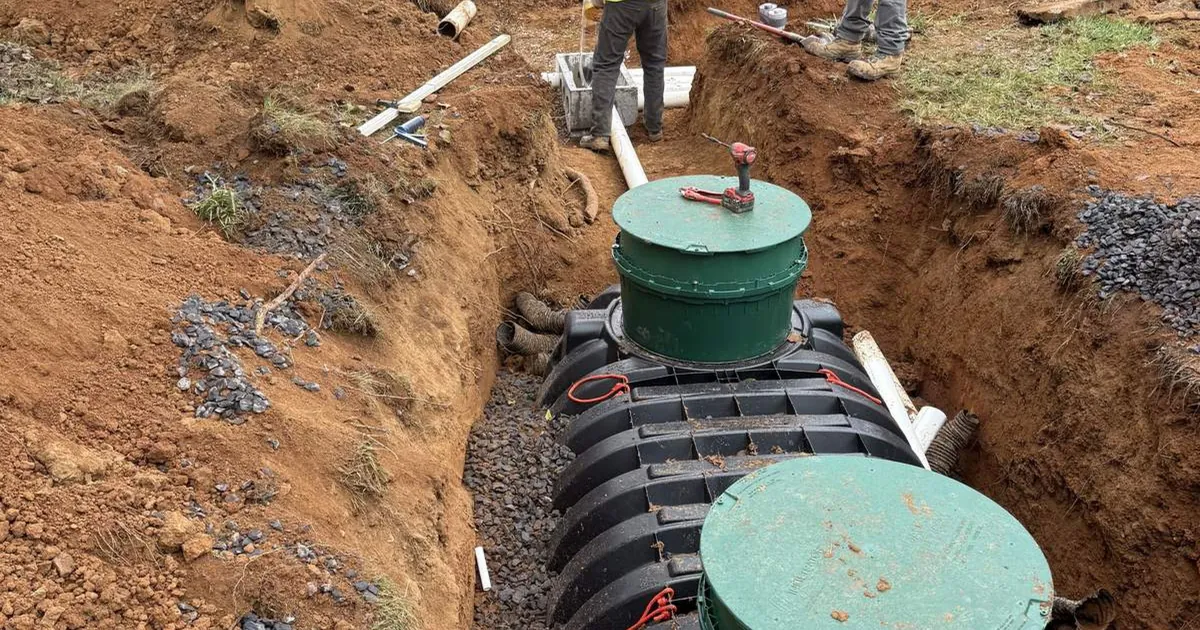
JRC Construction does septic system installation around Burlington, along with the site work a raw lot needs. The well is a separate trade, and a well contractor drills it.
What does each part of a well and septic system cost?
The market ranges come from two national cost guides, and the fees from Alamance County’s 2025/2026 schedule.
| Item | Published figure | Kind of source |
|---|---|---|
| Drilled well, 200 feet deep, complete | $6,000 to $16,000 on average | National cost guide, 2026 |
| Septic system installation | $3,586 to $12,463 | National cost guide, 2026 |
| Well and septic system together | About $9,600 to $28,500 | Our arithmetic |
| Improvement Permit, 1 to 3 bedrooms | $290 | Alamance County fee schedule |
| Construction Authorization, conventional system | $275 | Alamance County fee schedule |
| New well permit | $410 | Alamance County fee schedule |
| County permits for the pair | $975 | Our arithmetic |
The well guide’s range covers drilling, casing, pump installation, electrical connections and permits. A complete installation runs $30 to $80 or more per foot, and drilling alone runs $20 to $30. The guide warns that the pump, the pressure tank and the wiring are not always included in a per-foot quote.
Since that range already counts permits, the county fees are not a pure add-on. Check whether each quote includes them. Other counties set their own fees.
The septic guide says tank size, system type and the labor to install the drain field drive its range. For the septic side by system type, see our guide to septic system cost in North Carolina.
Why does the depth of the well move the price most?
Wells are priced by the foot, so depth is the main cost factor, the national well guide says. It puts residential wells at 100 to 300 feet deep on average. Its prices climb with every 100 feet.
| Well depth | Complete installation | Drilling only |
|---|---|---|
| 100 feet | $3,000 to $8,000 or more | $2,000 to $3,000 |
| 200 feet | $6,000 to $16,000 or more | $4,000 to $6,000 |
| 300 feet | $9,000 to $24,000 or more | $6,000 to $9,000 |
| 400 feet | $12,000 to $32,000 | $8,000 to $12,000 |
In the Piedmont, the bedrock sits under a layer of weathered clay. NC State Extension says that layer is typically 30 to 70 feet thick, and it can reach 300 feet. It adds that state standards require solid casing down to the bedrock, grouted in place.
Casing is also priced by the foot. The national guide puts PVC casing at $7 to $11 a foot, so deeper rock means more casing. Distance matters too, since longer water and electrical lines to the house raise the total.
How far apart must the well and septic system be?
At least 50 feet, for a private well serving one house. State rules keep that well 50 feet from the septic tank and the drain field, repair area included. The well rule (15A NCAC 02C .0107) and the septic rule (15A NCAC 18E .0601) both set that distance. The repair area is land the septic permit sets aside for a second drain field.
Other distances stack up on the same lot:
- The well sits at least 25 feet from the house, counting attached garages, patios and decks (.0107).
- The well sits at least 25 feet from the sewer line between the house and the septic system (.0107).
- The well cannot sit where surface water or runoff collects around it (.0107).
- The septic system sits at least 10 feet from any property line (.0601).
- In most cases, the septic system also sits 10 feet from any water line (.0601).
- A shared or community well needs 100 feet from the septic system (.0601).
So the well, the septic system and its repair area all need a spot before the house site is fixed. On a small lot, those distances can decide where the house goes.
Who permits and inspects the well?
The county health department does. G.S. 87-97 has every county run the private well program through its local health department. Alamance County Environmental Health permits and inspects drinking water wells. A new well moves through these steps:
- The county visits the proposed well site before it issues a permit.
- If a septic system is on the lot or planned, the well application includes a plat or site plan.
- The health department decides within 30 days, and no one may build the well without its construction permit.
- After drilling, the county inspects the well, including the cement grout around it.
- No one may use the new well until the county issues a certificate of completion.
- Within 30 days after that certificate, the county tests the water or makes sure a lab has.
Alamance County lists water samples separately: $65 for a bacteriological sample, $135 for the full inorganic panel. Ask the county which samples the well permit covers.
State law also bars anyone from well contractor work without a state certification (G.S. 87-98.4). We leave the well to a well contractor. The septic side runs through its own county permits, covered in our guide to the septic permit process.
What other site costs come with a raw lot?
Alamance County charges a $95 revisit fee when a property is not properly prepared for its staff. On a wooded lot, that preparation can start with land clearing.
A gravel driveway has to fit around the well, the tank and the drain field. Because the company also builds homes, we plan a new septic system around the house and the driveway. Our guides to land clearing cost per acre and gravel driveway cost cover those numbers.
How do you get a real number for your lot?
Start with the county. Its well visit finds a suitable site for the well. The Improvement Permit shows where the septic system goes and which type the soil allows. With both on paper, each quote can price the real lot.
A well contractor quotes the well. JRC Construction installs complete septic systems for new homes, and new systems in place of failed ones, around Burlington. We have the equipment for the whole job. Once the county permits are in place, an installation is often a one-day job.
See how a job runs on our complete septic system installation page. For a free quote in writing, call or text (336) 516-7170.