
Septic vs sewer: which costs less in North Carolina?
Septic vs sewer has no single winner. If no sewer line reaches your lot, you have no choice: the house needs a septic system. Where a line reaches the lot, the city decides, and state law sets the limits.
When you have a choice, the soil and the distance to the line decide most of it. A conventional septic system tends to cost less when the soil passes and the lot sits outside the city limits. Sewer tends to win when the soil rules out a conventional system on a lot inside the limits.
Every figure here is a published market number or a public fee, not our price list. We do septic system installation around Burlington. Sewer connections are not a service on this site, so the sewer side here is education.
How do septic and sewer costs compare?
Sewer means a one-time connection cost plus a monthly bill. Septic means a one-time system plus pumping. The sewer column uses the City of Burlington’s 2026 fee schedule. The septic column matches our guide to septic system cost in North Carolina.
| Cost | Conventional septic system | City sewer in Burlington |
|---|---|---|
| To build or connect | $3,000 to $8,500 installed, across two national cost guides | Private pipe, house to tap: $1,421 to $5,775 in one national cost guide |
| Public charges | $565 in Alamance County permits, three bedrooms | Tap: $3,800 inside the limits, $7,600 outside. Development fee: $1,406 for a 3/4-inch meter |
| To keep running | Pumping every 3 to 5 years, $290 to $550 a visit in one national cost guide | $6.46 per 1,000 gallons inside the limits, double that outside |
| If it fails | $5,000 to $15,000 to repair or replace, the EPA says | $1,400 to $4,100 to repair or replace the pipe in one national cost guide |
We did not add the $565 to the septic range. One of those two guides already counts permits in its total. Other counties and cities set their own fees.
What does city sewer cost in Burlington?
Burlington’s 2026 fee schedule lists a single-family 4-inch sewer tap at $3,800 inside the city limits and $7,600 outside. The sewer system development fee goes by water meter size. It is $1,406 for a 3/4-inch meter, with no separate outside figure.
By our arithmetic, those two charges come to $5,206 inside the limits and $9,006 outside. Those are the city’s charges, not the whole cost. The tap fee applies when city crews make the connection.
The private pipe from your house to the tap is a separate cost, and it is yours. One national cost guide says most homeowners pay $1,421 to $5,775 for a sewer line. It also prices the work at $50 to $250 per linear foot, so a long run climbs fast.
Add that range and the total runs about $6,627 to $10,981 inside the limits, or $10,427 to $14,781 outside. That is our arithmetic, and city staff determine all connection costs where a line abuts your property. National cost guides run wider for a whole connection: $250 to $55,000 in one, and $500 to $20,000 in another.
Burlington bills sewer at $6.46 per 1,000 gallons inside the limits, and double that outside. Assume 5,000 gallons a month, which is our number and not the city’s. By our arithmetic, that is $32.30 a month inside and $64.60 outside, or $387.60 and $775.20 a year.
What does a septic system cost to own?
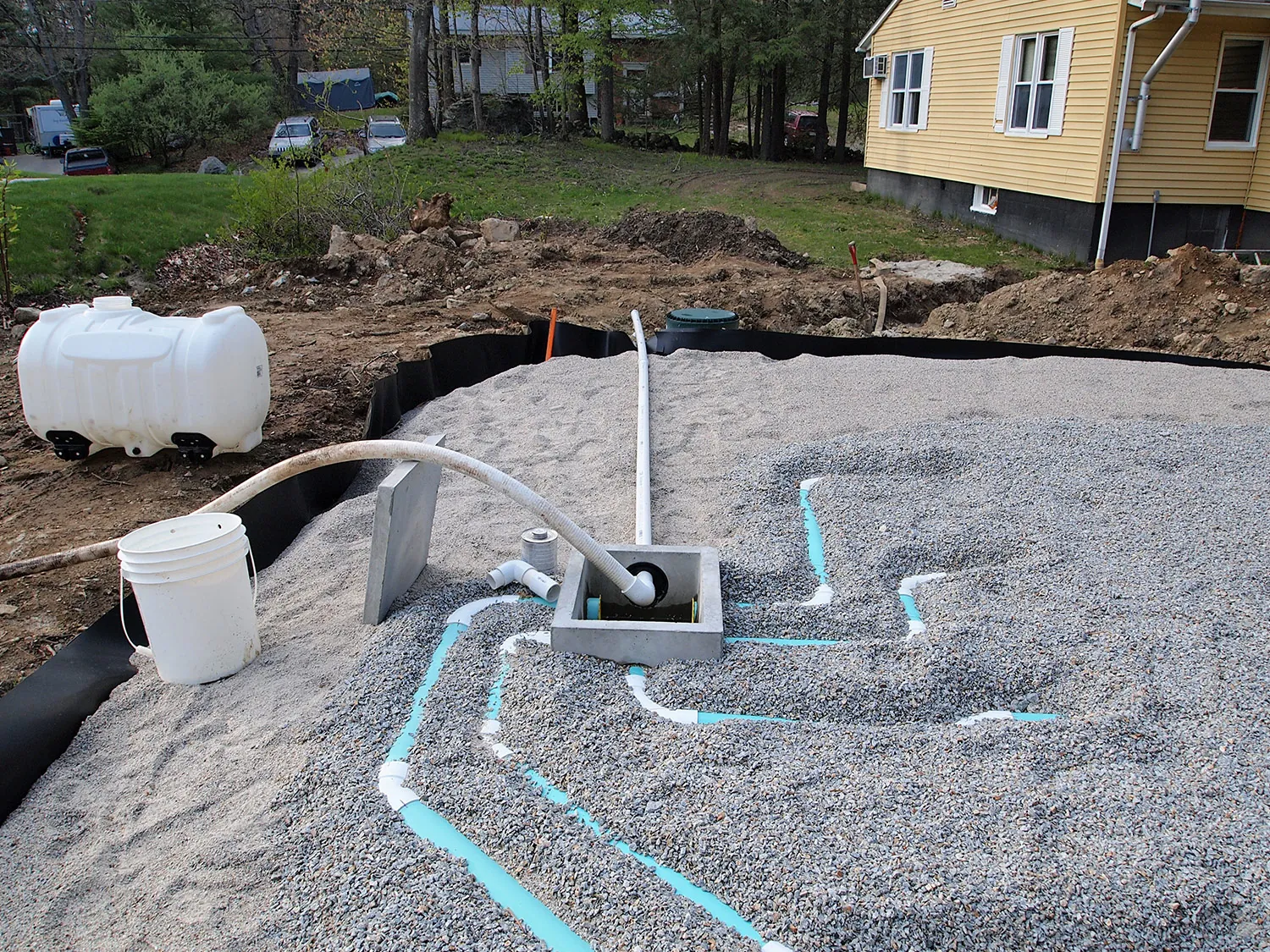
National cost guides put a conventional system at about $3,000 to $8,500 installed. In Alamance County, the Improvement Permit is $290 for up to three bedrooms, and the Construction Authorization is $275. That is $565 in county permits for a three-bedroom house on a conventional system. State rules set the minimum septic tank at 1,000 gallons for up to four bedrooms and 1,250 for five.
The soil can change all of that. The county’s soil evaluation decides whether your lot qualifies for a conventional system. NC State Extension says a low-pressure pipe (LPP) system may cost twice as much to install. State rules also call for an operator to visit an LPP system twice a year.
Septic has no monthly sewer bill, but it has upkeep. The state’s septic fact sheet says to have solids pumped out every 3 to 5 years. A state-permitted pumper does that work, a separate trade we do not do.
One national cost guide puts a visit at $290 to $550. By our arithmetic, that runs about $58 a year ($290 every 5 years) to $183 ($550 every 3).
NC State Extension says a well-kept system lasts about as long as an asphalt shingle roof. When one fails, the EPA puts the repair or replacement of a conventional system at $5,000 to $15,000. We answer a failed system with a new one under the county’s repair permit, our septic system replacement work.
When does each one cost less?
Match these conditions to your lot.
Septic tends to cost less when:
- The soil passes for a conventional system.
- The lot sits outside the limits. Burlington’s $9,006 in city charges tops the $8,500 high end of the conventional range.
- The house sits far from the line, because the private pipe is priced by the foot.
Sewer tends to cost less when:
- The soil rules out a conventional system, and the county calls for an LPP or another alternative system.
- The lot is inside the limits with a short pipe run. At the low end, our arithmetic puts sewer at $6,627, inside the conventional range.
Running costs lean toward septic while the system works. In our example, sewer inside the limits runs $387.60 a year, against $58 to $183 in pumping. One failed system can erase that gain.
Can a city make you connect to sewer?
Sometimes. G.S. 160A-317 lets a city require the owner of developed property to connect. That covers a home or business inside the city limits, within a reasonable distance of a city sewer line. The statute applies to cities, and it does not say every lot must connect.
It also has exemptions, such as a city that lacks capacity for the new wastewater. An owner is also exempt if connecting, underground piping included, would cost more than an on-site system. A licensed soil scientist, a licensed plumbing contractor or an on-site wastewater contractor with state certification makes that comparison.
An owner who takes that exemption has sole responsibility for the on-site system. A city can also bill a periodic availability charge in place of a connection, to avoid hardship.
This is general information, not legal advice. Ask the city that runs the line about your own lot.
How do you find out which one fits your lot?
Start with the city. In Burlington, an owner on a well or septic who wants sewer completes a Utility Service Request with Engineering. City staff then determine if sewer is available. If it is not, there is no hookup to price, only a line extension to discuss.
If sewer cannot reach the lot, or your numbers favor septic, apply to the county’s Environmental Health program. It evaluates the soil and issues the Improvement Permit. Some lots need pits dug first, and that digging is ordinary excavation work. Our guide to the septic permit process walks through each step.
Then get a written quote built on that permit. JRC Construction installs complete septic systems for new homes and new systems in place of failed ones around Burlington. See how a job runs on our complete septic system installation page. For a free quote in writing, call or text (336) 516-7170.