
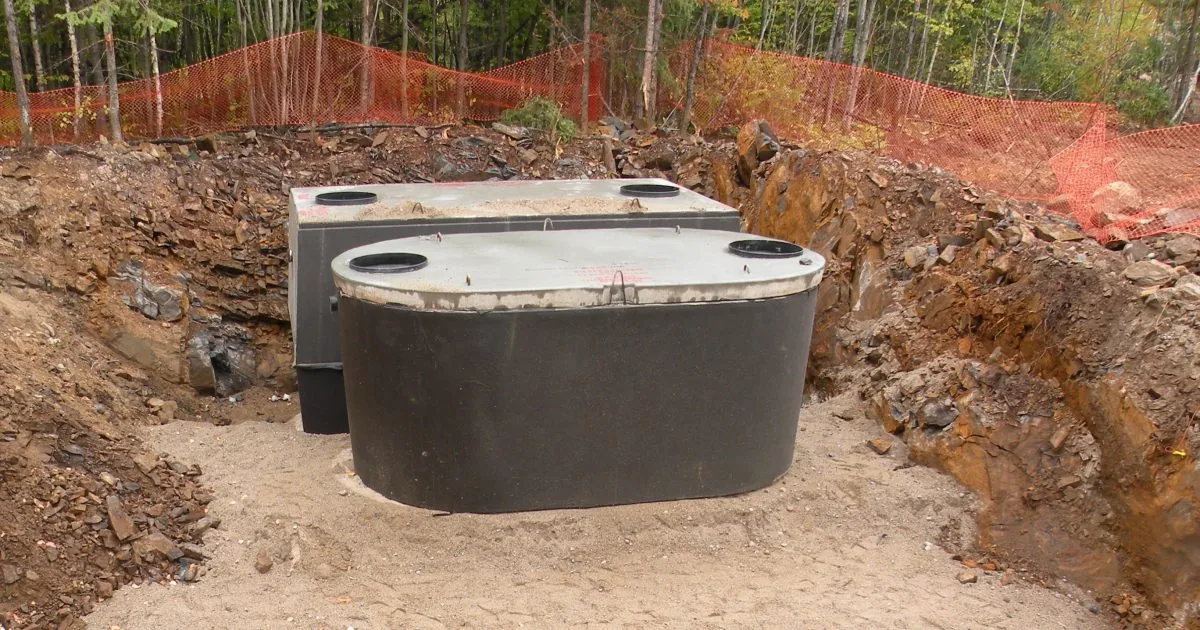
Concrete vs plastic septic tank: which is better in North Carolina?
Neither one wins on every lot. Both are legal in North Carolina when the tank model is approved by the state. The lot decides more than the price does.
A wet site, or a spot that vehicles will cross, leans toward concrete. The state’s 2024 approval for one plastic tank line bars any vehicle loading. It also requires measures that keep those tanks from floating on wet sites.
The price gap is small. One national cost guide puts a plastic tank at $500 to $2,000 and concrete at $700 to $2,000. Every figure here is a published market number or a state rule, not our price list. We do septic system installation around Burlington.
Is a concrete or plastic septic tank better?
On a dry lot with no traffic, either one can work. North Carolina’s tank rule names precast concrete tanks, and it also names thermoplastic and fiberglass tanks. What counts is a state-approved model that suits the site.
Even the national cost guide says groundwater level and yard space help decide the tank material. Its lifespan range for plastic starts higher, at 30 years against 20 for concrete. The bigger split is the site. Wet ground and vehicle traffic both limit the plastic line approved in 2024.
How much does each tank cost?
One national cost guide, updated in October 2026, lists these tank-only prices and lifespans.
| Tank material | Tank-only cost | Lifespan | What to watch |
|---|---|---|---|
| Plastic | $500 to $2,000 | 30 to 40 years | Held down on wet sites; no vehicle loads; buried 36 inches deep at most (2024 approval) |
| Concrete | $700 to $2,000 | 20 to 40 years | Misaligned seams or exposed reinforcement can prompt a health department leak test |
| Fiberglass | $1,200 to $2,000 | 30 to 40 years | The highest starting price of the three |
Plastic starts $200 lower, and both top out at $2,000. The same guide says labor makes up 50 to 70 percent of a septic system’s total cost.
For a three- or four-bedroom home, it puts a 1,000-gallon tank at $900 to $1,500 for the tank alone. For whole-system prices, see our guide to septic system cost in North Carolina.
Fiberglass is the third choice. Rule .1402 names glass-fiber-reinforced polyester tanks, and the guide prices one at $1,200 to $2,000. Its lifespan matches plastic, at 30 to 40 years.
Which tanks does North Carolina allow?
All three, as long as the tank model is approved. Under 15A NCAC 18E .1401, every tank used in a wastewater system must be approved by the state. The state’s On-Site Water Protection Branch approves them, and Branch engineers review each design. A maker’s plans must state the tank’s material type and strength.
Some rules apply to every septic tank. Material does not change them:
- Watertight and structurally sound, and not subject to corrosion or decay (.1402(a)).
- At least 1,000 gallons: 1,000 for a house with up to four bedrooms, and 1,250 for five (.0801).
- A liquid depth of at least 36 inches, with two compartments inside (.1402).
- An imprint with the maker, the serial number tied to its approved plans and the capacity (.1402). It sits at the outlet end, to the right of the outlet pipe.
- Set level within one inch each way, on bedding and backfill per the maker and the tank approval (.0805).
- At least two feet of undisturbed soil between the tank hole and the drain field (.0805).
The state or the local health department may inspect a tank at the install against its approved plans (.1401). The county permits come first, and our guide to the septic permit process covers each step.
What happens to a plastic tank in wet ground?
The 2024 approval for one plastic tank line has a wet-site rule. A site with saturated soil, or signs of a seasonal high water table, must use anti-buoyancy measures. In plain words, the tank gets held down so groundwater cannot float it.
That maker’s guidance, posted on the state’s site, sets the trigger. Hold-downs may be needed when both of these are true:
- Groundwater can rise 30 inches or more above the tank bottom.
- Less than 12 inches of soil will cover the tank top.
With at least 12 inches of soil over the top, the guidance calls for none. It also says not to install the tank where groundwater outside it can rise above the outlet pipe.
Hold-downs add parts and labor. The guidance lists wood or concrete beams set beside the tank and strapped across its top. Other options include precast concrete plates and a concrete collar. On a wet lot, compare quotes with the hold-downs priced in.
Can you drive over a septic tank?
Only if the tank is designed for it. Rule .1401 says any tank designed for traffic loads must be designed by a professional engineer. Its plans must show the traffic load the tank is designed to support.
The 2024 approval for one plastic tank line goes further. Those tanks may not go anywhere that will carry vehicle loads of any kind. That rules out a driveway or a parking spot over the tank.
Plan the driveway before the tank goes in. If a gravel driveway has to pass near the system, keep the tank out of the wheel path. Because the company also builds homes, we plan a new system around the house and the driveway.
How long does each one last?
The national cost guide gives concrete tanks 20 to 40 years. It gives plastic or fiberglass tanks 30 to 40. The ranges overlap, and both top out at 40 years.
The same guide ties a tank’s life to its material. Upkeep and daily use count too.
The install can be checked as well. The health department can order a leak test for misaligned seams, exposed reinforcement or damage from transport. In the water test, the tank is filled and left to sit for one hour. It passes if the level drops one-eighth inch or less.
Which one fits your lot?
Start with the site, then compare prices. These questions sort it out:
- Is the ground wet, or does the soil show signs of a seasonal high water table? The 2024 plastic line must be held down there.
- Will any vehicle cross the tank spot? Then the tank must be designed for traffic loads, and the 2024 plastic line is out.
- Will the tank sit deep? That plastic line may be buried no deeper than 36 inches below grade.
- Can the delivery truck and the excavator reach the hole? Tight access belongs in the quote.
If your old system failed, the new one goes in under the county’s repair permit. That is our septic system replacement work. Setting any tank is excavation work, from a level hole to the last of the backfill.
JRC Construction installs complete septic systems for new homes, and new systems in place of failed ones, around Burlington. We have the equipment for the whole job. Once the county permits are in place, an installation is often a one-day job.
The written quote names the tank the county permit and the lot call for. See how a job runs on our complete septic system installation page. For a free quote in writing, call or text (336) 516-7170.