
What Is the Best Gravel for a Driveway in North Carolina?
For most North Carolina driveways, the best gravel is crushed stone in two layers. The base is crush and run, crushed stone with its fines left in, so it packs hard. The state road department’s version is called ABC, short for aggregate base course. Crush and run often works as the top layer too.
Clean stone such as No. 57 drains well, but it stays loose under tires without a packed base. Smaller clean stone, like No. 67 or No. 78M, makes a finer top. We build gravel driveways around Burlington on a packed base. Each stone below goes by its number in the state’s stone table.
Which driveway stone does what?
The state road department grades stone by how much of it passes each size of screen, called a sieve. A No. 4 sieve has openings about 3/16 inch wide. Grains small enough to pass a No. 200 sieve are the fines, too small to see one at a time.
| Stone | Sizes in the state’s table | Fines | Packs or drains | Where it goes |
|---|---|---|---|---|
| Crush and run (ABC) | All passes 1 1/2 inches; 35 to 55 percent passes No. 4 | 4 to 12 percent | Packs hard | The base, and often the top |
| No. 57 stone | 95 to 100 percent passes 1 inch; 0 to 10 percent passes No. 4 | Almost none | Drains; loose on its own | A top layer on a packed base |
| No. 67 stone | All passes 1 inch; 90 to 100 percent passes 3/4 inch | Almost none | Drains | A smaller-stone top layer |
| No. 78M stone | All passes 3/4 inch; 98 to 100 percent passes 1/2 inch | Very little | Drains | A finer top layer |
| Pea gravel, river rock | Not in the state’s table | Not listed | Rounded; shifts under tires | Not the driving surface |
What is crush and run (ABC stone)?
Crush and run, also called crusher run, is crushed rock in every size from 1 1/2 inches down to dust. The small pieces fill the gaps between the big ones. Packed down, the mix sets into a firm, tight layer that carries weight.
The Federal Highway Administration’s gravel roads guide gives the recipe. Good gravel needs the right blend of stone, sand and fines. Crush and run has all three. The guide also wants fractured stone, and it says quarry stone is almost all fractured pieces.
The state road department, NCDOT, calls its version ABC, for aggregate base course. ABC stone is another name you will hear for crush and run.
What is No. 57 stone?
No. 57 stone, or just 57 stone, is clean crushed stone with almost no fines. In the state’s table, 95 to 100 percent of it passes a 1-inch screen. Only 0 to 10 percent passes the No. 4 sieve. So most of it is stone between about 3/16 inch and 1 inch.
With nothing to fill the gaps, water runs right through it. The state lists No. 57 for shoulder drains and sediment control stone, along with structural concrete and asphalt surface treatment.
Those open gaps also leave it loose. The federal guide warns about stone with very little fine material. Used as a surface, it “will not form a crust to keep the material bound together.”
Crush and run vs 57 stone: which is better for a driveway?
For the base, crush and run is the better stone. Its mix of sizes packs into a firm layer, while 57 stone has no small pieces to fill its gaps. For drainage alone, 57 stone wins, because water passes straight through.
The difference comes down to fines. Crush and run has them, and packed down, they lock the stones together. No. 57 has almost none, so it stays loose unless something holds it in place.
You can also use both: crush and run packed for the base, then clean stone on top. The packed base gives the top stone something firm to lock into.
Which gravel goes on top?
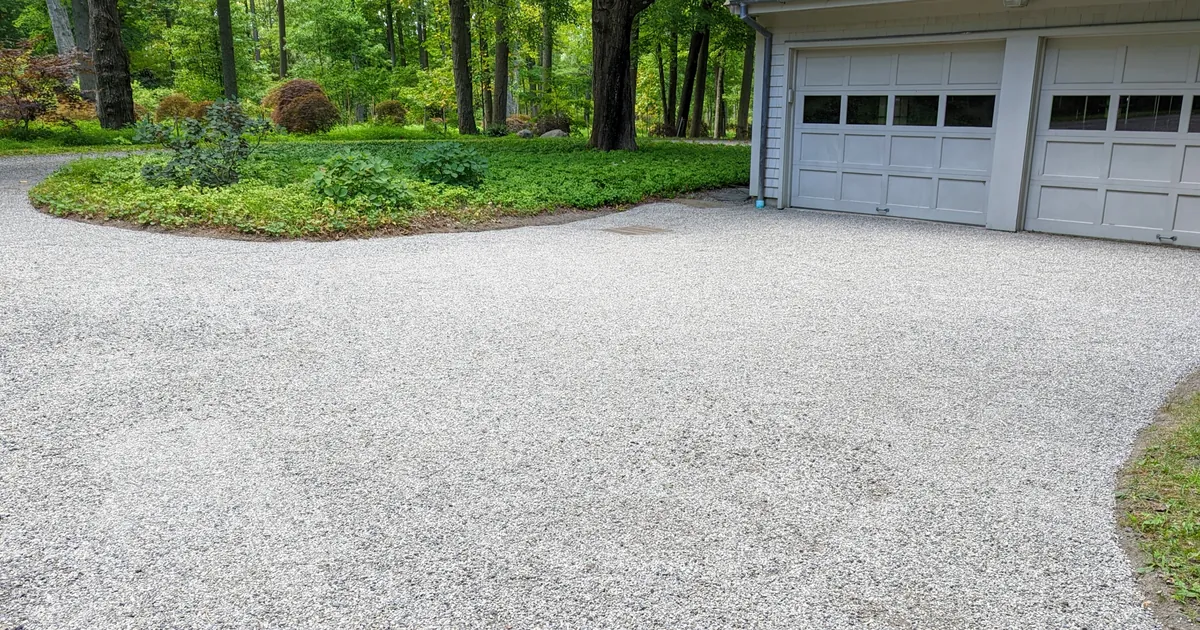
Crush and run can be the top layer as well as the base. Packed and crowned, it makes a firm surface that sheds rain to the edges. Its fines do make some dust. The federal guide notes that some fines are lost under traffic as dust that blows away.
A clean stone top has almost no fines to lose as dust, but it stays looser. The guide says traffic tends to push gravel from the surface toward the edges. How thick each layer goes is its own question. Our gravel driveway cost guide covers depth, along with prices per ton and per foot.
What about smaller stone, like No. 67 and No. 78M?
No. 67 stone is a step smaller than 57. In the state’s table, all of it passes a 1-inch screen, and 90 to 100 percent passes 3/4 inch. No. 78M is smaller again: all of it passes 3/4 inch, and 98 to 100 percent passes 1/2 inch.
Smaller stones leave smaller gaps, so a top layer of 67 or 78M is finer than one of 57. No. 78M also carries more small chips, with 20 to 45 percent passing the No. 4 sieve. Both are still clean stone, so they need a packed base under them.
When you compare quotes, ask which stone number goes in each layer. The word “gravel” covers all of these and more. As the federal guide puts it, “all gravels are not the same.”
Are pea gravel and river rock good for a driveway?
Not as the driving surface. Pea gravel is small, smooth, rounded stone, and river rock is larger stone smoothed by water.
The federal guide says natural stone with a rounded shape tends to shift and move under loads more easily. Crushed stones embed into a gravel surface much better than rounded ones, it adds. They also resist movement under loads better. For the part your tires touch, choose crushed stone.
How do red clay and drainage change the choice?
Even the right stone struggles on soft ground. The federal guide calls the soil the most important part of the road structure. On a red clay lot, water that soaks into that soil can soften it.
Wet clay can also creep up into new stone. The guide says traffic pumps water and fine soil up from below, and that weakens the new stone very quickly. Fabric laid on the soil first acts as a separator between the two.
Then the water has to leave. The guide repeats an old saying from road builders: “drainage, drainage, and drainage” are the three most important things. A crown sheds rain off the surface, and land grading sends yard runoff around the driveway instead of across it. On a wooded lot, the job starts sooner, with land clearing along the route.
How do we choose the stone for your driveway?
JRC Construction builds new gravel driveways and extensions. We also regrade worn driveways and add fresh stone where it has thinned. We work within about 55 miles of Burlington.
We look at the route and where the water goes, then talk through the stone for each layer. Then we put a free quote in writing. Call or text (336) 516-7170, or read more about our gravel driveway service.